
How to Practice Your FlowMotion Education Exercises
“Think Different”
OK yes, I stole this from Apple, possible grammatical error and all.
A Joint-centric approach: focus on your bones/joints/skeleton and forget you even have muscles. Wait — what!?!?
If you’ve ever been taught an exercise program (gym, physical therapy, yoga, etc.), you are probably used to a focus on strengthening and stretching muscles. I have a different perspective, and for many of my clients/students, initially it’s a little bit of a leap. My focus is on your joint motions — both individual joint motions, and coordinated joint motions (teaser hint: yes your knee’s ability to bend and straighten directly impacts your spine’s ability to rotate!). From my perspective, if your joints are doing the right thing, by definition your muscles are doing the right thing. Let me repeat that statement to give it the emphasis it deserves: if your joints are doing the right thing, by definition you muscles are doing the right thing. I invite you to visualize your skeleton and individual joints while performing your exercises, and forget you even have muscles. Yes, of course you might feel muscles elongating (stretching) and contracting (engaging). Maybe you will even feel your muscles elongating and engaging at the same time, because much of the time that is in fact what is occurring.
Visualize your skeleton — forget you even have muscles!!!!
Answer to FAQ: how many reps?
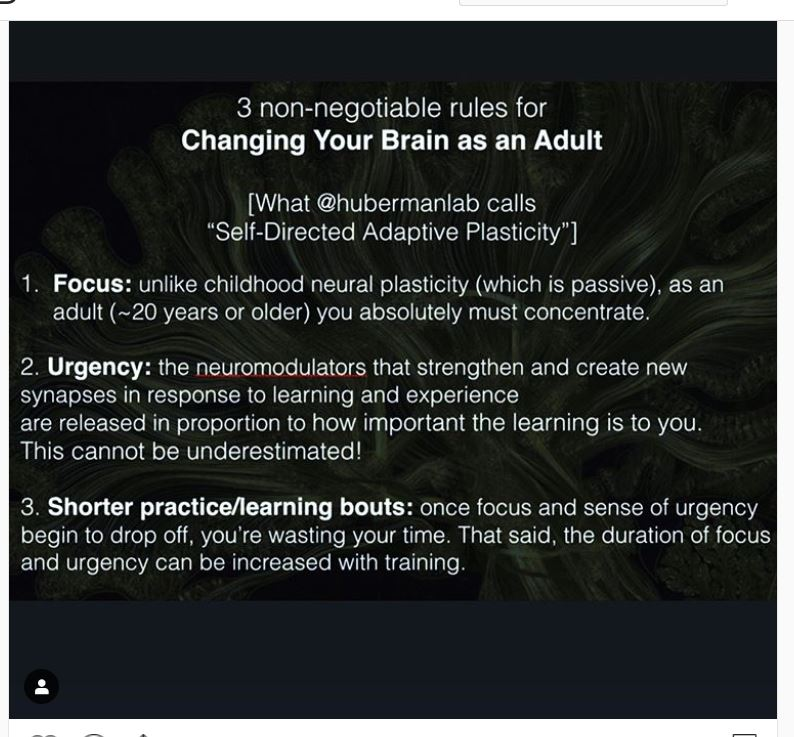
If you’ve ever been taught an exercise program (gym, physical therapy, yoga, etc.), you are probably used to a specified number of reps and sets. We (not the editorial “we”, but rather the you and I “we”) are working in the realm of neuroplasticity. This is just a fancy way of saying, we are attempting to change — and in fact optimize —the way your brain orchestrates movement, using the lovely metaphor of the brain as conductor and your joints as musicians. Strength and flexibility will inevitably be a byproduct of optimizing movement. So, how do we change the adult brain (yes, I do have some children in my mix, but most of my clients/students are adults)? I follow Dr. Huberman on social media: a Stanford neuroscientist with his own research lab, who incredibly generously and clearly shares his research with lay people. I share his research as our response to: “how many reps?”
I hate to be so nebulous, but this truly is my answer. If you need a number, we do low reps with focus, intention, and awareness, e.g. 5 reps. Yes, I actually send the below image to all new clients!
“More is not better. Better is better.” (Alex Steffen)
Nitty gritty details for all exercises I teach:
- Pain is completely subjective, but in general, none of your exercises should cause pain, and if they do, stop doing them and communicate this to me. However, if you feel a slight twinge, perhaps try the exercise again without forcing anything. If the twinge reduces, which it often does with repetition (your brain is not startled into producing a twinge-of-pain response), then keep doing the exercise.
- Always have an awareness of your foot tripod (three points of contact, big toe ball/knuckle, little toe ball/knuckle, and heel bone — please watch my Foot Tripod video on YouTube if you haven’t already done so).
- Be mindful of your toes! Don’t let your toes scrunch or grip. Make sure your toes are flat and not “clawing” when performing your exercises. Your toes are the last line of defense, and will take over when the rest of your foot is not doing its job.
- Exercises performed in bilateral stance (as opposed to a split stance where one foot is forward of the other): be aware of weight distribution between your feet — is one foot bearing more weight than the other?
- Forget you have muscles, and focus on visualizing your bone/joint motions. Picture your skeleton when performing your exercises. (See above).
- Edge exploration or “finding your center”— The course that I have taken from my primary teacher Gary Ward is called “Finding Centre” (he is British, hence “centre”). How do you find center? In order to find center, we must find our boundaries or edges. Otherwise how do we know where center is? This concept is worthy of some thought. In movement this translates to finding your range of motion in all joints in all available dimensions (almost all of your joints move in three dimensions). Your brain may have forgotten certain ranges of motion, and its perception of center may have shifted. By re-exposing your brain in a safe controlled environment to ranges it may have forgotten, your brain will recalibrate its perception of center.
- Practice with engagement and curiosity. Don’t just go through the motions (see Huberman above — how the adult brain learns). In your mind, start substituting the word “exercise” with the word “exploration” — “what happens if I…?”
- When walking don’t think about any of this. A single footstep happens in less than a second. You cannot consciously control your gait in real time. The changes occur in the mindful, engaged practice of your exercises. Feel free to notice changes. And feel free to think about moving with FlowMotion.
How to use these exercises:
We are all somewhere on the spectrum:
PAIN ——————————- PREVENTIVE MAINTENANCE ——————————- PERFORMANCE
The exercises I teach can be used as a regular practice and/or as a toolbox. If you are in the prevention/performance range of the spectrum, I recommend you take the time to learn the exercises, and then turn them into a flow as a regular practice. I cannot give a generic answer to the question: how often should I do this practice? That is too individual — I don’t know what else you are doing. The exercises might take a while to learn to perform fluently. But once you know them, you will most likely find that the entire practice does not in fact take a long time to go through.
If you are in the pain realm, I recommend you consider these exercises both a practice and a toolbox. For example: “oh dear, my plantar fascia is flaring up again, but I know if I do Receive Your Mass and Re-supination, I will feel better.” Or, “my hip always feels better when I….”